AI-POWERED UPSC MAINS EVALUATION
The only way to crack Mains is to write.
The only way to improve is feedback.
AI-evaluated answers across 23 papers. Structured feedback in under a minute.
The sculptors filled the Chandella artform with resilient vigor and breadth of life. Elucidate. (Answer in 150 words)
The answer follows a traditional three-paragraph structure with a clear introduction and conclusion. However, the presentation is somewhat monotonous as it lacks subheadings or bullet points. In a 150-word UPSC answer, using subheadings like 'Breadth of Life: Thematic Diversity' and 'Resilient Vigor: Artistic Style' would have significantly improved the scannability and highlighted the aspirant's ability to categorize information logically.
The aspirant correctly identifies the Khajuraho temples and the diverse themes ranging from the mundane to the divine. However, the content is missing specific factual anchors that distinguish a high-scoring answer, such as the mention of specific temples (e.g., Kandariya Mahadeva or Lakshmana Temple), the use of 'sandstone' as the primary material, or the 'Nagara' style of architecture. While it mentions 'dynamic poses,' it fails to use technical art terms like 'Tribhanga' or 'Mithuna' figures which are central to Chandella art.
The answer makes a good attempt to analyze the symbolism of erotic sculptures as a harmony between the worldly and spiritual. However, the 'resilient vigor' aspect is treated descriptively rather than analytically. A deeper analysis would have linked this vigor to the socio-political context of the Chandella Rajputs or explained how the 'breadth of life' reflected the Tantric influence of the period, which integrated all aspects of human existence into the religious fold.
The answer is strictly historical and lacks any connection to the present. To enhance the answer, the aspirant could have mentioned the UNESCO World Heritage status of the Khajuraho Group of Monuments or the annual Khajuraho Dance Festival, which continues to celebrate the 'breadth of life' (specifically the performing arts) depicted in the sculptures. Mentioning the Archaeological Survey of India's (ASI) efforts in preserving these 'resilient' structures would have added a contemporary touch.
INPUT MODES
Type your answer, or photograph what you wrote by hand.
Same evaluation engine either way. Choose what fits the way you practise.
Type it
Write your answer in the editor with a live word count. Submit and get structured feedback in under a minute.
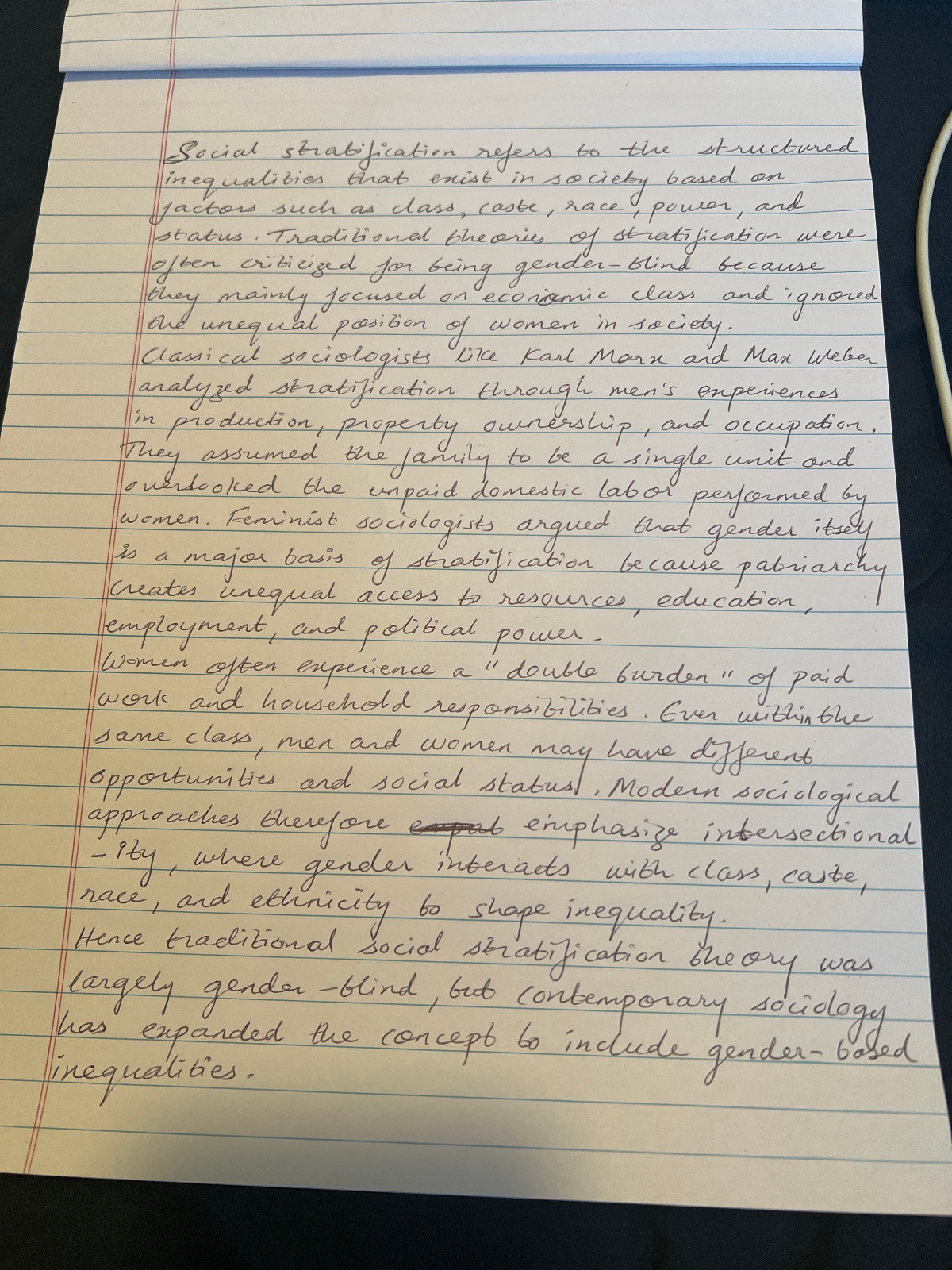
Social stratification refers to the structured inequalities that exist in society based on factors such as class, caste, race, power, and status. Traditional theories of stratification were often criticized for being gender-blind because they mainly focused on economic class and ignored the unequal position of women in society. Classical sociologists like Karl Marx and Max Weber analyzed stratification through men's experiences in production, property ownership, and occupation. They assumed the family to be a single unit and overlooked the unpaid domestic labor performed by women. Feminist sociologists argued that gender itself is a major basis of stratification because patriarchy creates unequal access to resources, education, employment, and political power. Women often experience a "double burden" of paid work and household responsibilities. Even within the same class, men and women may have different opportunities and social status. Modern sociological approaches therefore emphasize intersectionality, where gender interacts with class, caste, race, and ethnicity to shape inequality. Hence traditional social stratification theory was largely gender-blind, but contemporary sociology has expanded the concept to include gender-based inequalities.
Photograph what you wrote
UPSC Mains is still a written test. Time yourself on hard copy sheets to create exam-like conditions. Upload a photo of your handwritten answer, review our OCR transcription, and evaluate.
DAILY CURRENT AFFAIRS
Mains-syllabus mapped current affairs, ready for your answers.
Daily high-yield analysis mapped directly to GS1–GS4 syllabus topics. Get the exact facts, judgments, and schemes you need to boost your Mains answer scores.
Broadening the Scope: Supreme Court Mandates Inclusion of Small Wetlands in Conservation Framework
The Supreme Court has expanded the definition of wetlands for ground-truthing purposes, mandating the inclusion of water bodies smaller than 2.25 hectares to strengthen local ecological and water security.
Streamlining Judicial Administration: Collegium’s Latest Recommendations for High Court Leadership
The Supreme Court Collegium has initiated a major administrative reshuffle by recommending new Chief Justices for four High Courts and clearing key appointments to address judicial vacancies.
Judicial Accountability and State Liability: Compensating Wrongful Incarceration
The Supreme Court has mandated compensation for wrongful detention due to investigative negligence, highlighting the critical intersection of fundamental rights, police accountability, and the need for administrative reform.
Sign in to unlock unlimited Mains-mapped current affairs for free. Start building your answer bank.
Sign inCOVERAGE
23 papers from day one
The evaluation engine is content-agnostic — every supported paper works without per-subject content pipelines.
COMPULSORY
Essay · General Studies I · General Studies II · General Studies III · General Studies IV
OPTIONALS
History · Geography · Political Science & IR · Public Administration · Sociology · Philosophy · Psychology · Anthropology · Law
Literature and technical or quantitative optionals are not supported — LLM evaluation of derivations and proofs is not yet reliable enough for high-stakes practice.
HOW ACCESS WORKS
Three ways to use JeetoBharat.
Free
Available now- One free AI evaluation to experience the engine
- Unlimited current affairs mapped to GS1–GS4 syllabus topics
- Browse every Mains previous-year question
Scholarship
For those who cleared Prelims 2026
- Unlimited current affairs
- AI evaluation of written Mains answers
- Monthly credit grant, enough for evaluation of several questions each month
Subscription
Coming late 2026- Unlimited current affairs
- AI evaluation with a monthly credit quota
- On-demand top-ups when the quota runs out
- Final pricing closer to launch
Study on the Web.
Photograph & Submit on Mobile.
JeetoBharat works seamlessly across all your devices. Draft your answers or read current affairs on your laptop, and use our mobile apps for the best photo-taking experience when submitting handwritten sheets.
Web Platform
Ideal for reading detailed current affairs articles, reviewing syllabus mappings, and tracking your historical attempt performance.
iOS & Android Apps
Best for writing practice. Snap high-resolution photos of your handwritten answers directly using your phone camera for instant AI evaluation.
Download the App
Get the companion app for iOS or Android and start practicing answer writing today.
Help us build JeetoBharat
What features will help you in your UPSC preparation? Suggest ideas, vote on requests, and discuss features with other aspirants.
Frequently Asked Questions
Is my handwriting supported?
Yes. Our transcription engine is built to handle standard cursive and messy handwriting typical of timed Mains exams. You will also have a chance to verify and edit the transcription before evaluating.
How do I claim my free evaluation?
Sign up, verify your phone number in the Account tab, and write or photograph your answer. The limit is strictly one free evaluation per phone number.
How accurate is the AI evaluation?
The AI is calibrated against official UPSC syllabi and past topper answers. It focuses on identifying structural gaps, missing concepts, and factual errors to give you actionable feedback.
Are my answers kept private?
Absolutely. Your answers are securely stored and only accessible by you. We do not use user-submitted answers to train public models.
Why do you require phone verification?
To prevent abuse and ensure fairness. AI evaluations cost us significant compute credits to run, so we use phone verification to ensure each real person gets exactly one free trial.
Do you support regional languages?
Currently, we only support answers written in English. We are actively exploring support for Hindi and other regional languages in the future.